

THE SCAVANGER OF DECAYING CIVILIZATIONS
Communism is no more than a system of false religion where adherents place faith in their founders: Marx, Hegel and Engels, and where the state has become their new god. It is, in essence, a system that allows evildoers in society to gain rule over men of good will. Those who turn to Communism do so as a relief from the sheer emptiness of life. God is punishing the world with revolutionary men and their organisations, which is chiefly Communism.
Communism and its revolutionary men want complete control, and they must wipe out their biggest enemy – priests – to gain the victory. God gave us the Ten Commandments to guide and protect us, but the Communists also have their ten commandments in the hope of invoking the curse of humanity. God says “I will set my Face against you, and you shall fall down before your enemies (revolutionary men), and shall be made subject to them that hate you, you shall flee when no man pursueth you”.
The ten commandments of the Communists show how priests are their main target in numbers one and three. This is simply because priests are the most powerful people in the world by their sacred ministry. This is why they are under constant and brutal attack.
THE TEN COMMANDMENTS OF THE COMMUNISTS
- Never forget that the clergy is the most powerful enemy of the Communist state.
- Try to win your friends over to Communism and remember that Stalin, who has given a new constitution to the Russian people, is the leader of the anti-God army, not only in the U.S.S.R. but throughout the world.
- Convince your friends not to have any contact with priests.
- Watch out for spies and report saboteurs to the police.
- Make sure that atheist publications are distributed among the largest possible number of people.
- A good young Communist must also be a militant atheist. He must know how to use weapons and be experienced in the art of war.
- Wherever you can, you must fight religious elements and prevent whatever influence they might have on your comrades.
- A true “godless” (comrade) must also be a good police agent. It is the duty of all atheists to guard the security of the state.
- Support the godless movement with your money, which is especially necessary for our propaganda abroad where funds, under present circumstances, can only be spent secretly.
- If you are not a convinced atheist, you cannot be a good Communist or a real Soviet citizen. Atheism is indissolubly bound to communism. These two ideals are the pillars of Soviet power.
Communism is a diabolical disorientation which apes and mimics Christ’s holy Church and her teachings. Christ gave us the three counsels of poverty, chastity, and obedience. These are counsels, not commands. They are commended, not commanded. But communism forces people to transfer their wealth at the whim of their dictators. Communists hate philanthropists who try to improve the present system, who, moved by love of God and neighbour, try to remedy the suffering of the poor.
Ever wonder where the separation of Church and State came from? It came from Communism. The underground Communist Party in the United States wrote the Bukharin pamphlet. This pamphlet states “The church must be separated from the state”. This was accomplished in 1920 just a few years before the last Holy Roman emperor, Blessed Karl von Hadsburgh, died in exile in Madeira in a cold, damp house. The revolution destroyed the Holy Roman emperor so that the state could become god. The Church was in the way of their revolution, so they wiped out the Holy Roman emperor to separate the Church from the State. The Holy Roman emperor was autonomous from the pope, but if the Holy Roman emperor defied the pope, the pope would place an interdict on the area in question. Since it was a Catholic empire, Catholics would depose an emperor when the pope placed the penalty of interdict. Catholics wanted their weddings, funerals, and other sacraments.
The end goal of Communism is world slavery. Speaking to the prioress of Carmel in 1849, Venerable Leo Dupont told her that men need to make reparation or communism would close churches and make them slaves of the State, that world revolution would spread, and Communism would enslave us all. Marxism seeks to make the individual to exist only for the good of society. If you think Communism is good for the world, think again. They have killed one hundred million people, a conservative estimate, for no good reason: twenty million in Russia, sixty-five million in China, and fifteen million in the rest of the world. We must look to their methodology and see if we can employ their own tactics against them.
Almost 200 years since these revelations has revealed to us that it is revolutionary men styling themselves as Socialists, then Progressives, Democrats, Nihilists, Liberals and communists who are taking over the Church and the world.
THE END OF COMMUNIST DICTATORS
LENIN
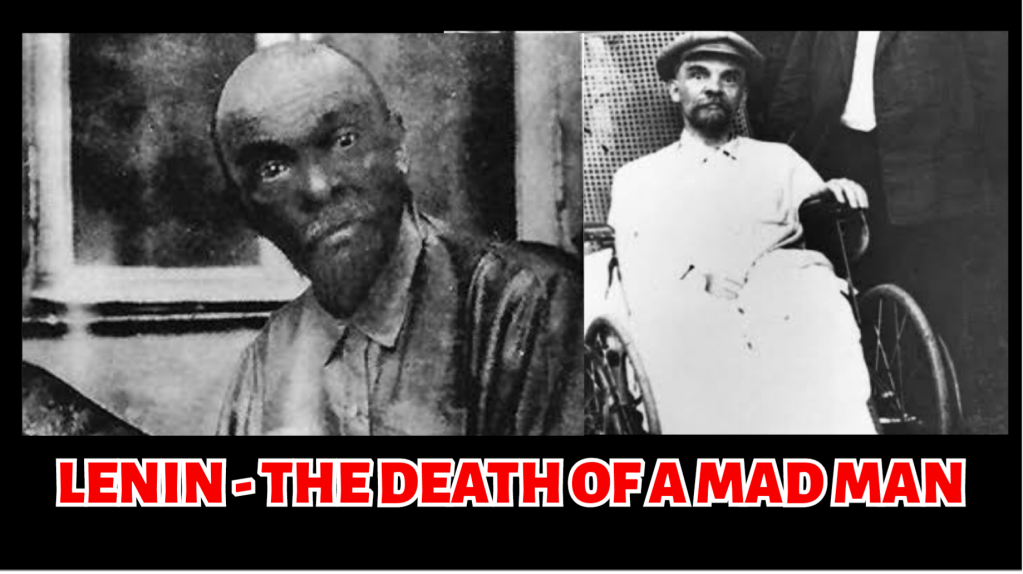
Here we will read an interesting story about the death of Vladimir Lenin which occurred on the 21st of January 1924. The story is second-hand and comes from a Hungarian priest who allegedly was there.
The first time this story was printed was in the October 1938 issue of a magazine called The Catholic Boy, published by the Holy Cross Fathers at Notre Dame, Indiana.
This story surfaces again in 1939 in another magazine called Catholic Digest. In this article it states the following:
A story is told by Father Michael D’Herbigny, S.J., who gives it on the authority of a priest who was a former friend of Lenin and who was with him shortly before his death. Father D’Herbigny is a renowned scholar and carefully weighs any statement before it is made, so any story he tells must have a good foundation.
This is the story: A Hungarian priest, a former classmate and confidant of Lenin, had from him, during a lucid interval in his last illness a statement which he repeated verbatim to me. “It was, I suppose, necessary to liberate a multitude of oppressed people; but our method has provoked other oppressions, frightful massacres. You know that my most awful nightmare is to feel myself drowning in an ocean of the blood of countless victims. To save our Russia, what we needed (but it is too late now) was ten Francis of Assisi. Ten Francis of Assisi and we should have saved Russia. “The Catholic Boy (Oct. ’38).
The magazine states that Father D’Herbingny had been to Russia before the printing of The Catholic Boy.
One 1956 book gives another story from D’Herbigny that would have happened around that same time.
Father Michel D’Herbigny, who was consecrated as a Bishop, apparently made two journeys to Soviet Russia until the Soviet authorities banned him.
Bishop D’Herbigny was a believer in Lenin’s sincerity and once told me a story of his last illness, when he was visited by a French priest who, when a young Communist, had become a close friend of Lenin in his exile.
He was welcomed by the dying Bolshevik leader, to whom he did not at first disclose his conversion. When he did, Lenin was furious, but at a second or third visit dropped his hostility, and even said that could he have had his time over again his ambition would have been to become the Russian St. Francis of Assisi. “In a hundred years,” he said, “there would have been only two forces — Bolshevism and the Catholic Church.
STALIN

At the moment of her father’s death, Josef Stalin’s daughter recalled: “The death agony was terrible. God grants an easy death only to the just. He literally choked to death as we watched. At what seemed like the very last moment he suddenly opened his eyes and cast a glance over everyone in the room. It was a terrible glance, insane or perhaps angry and full of fear of death. Then something incomprehensible and terrible happened that to this day I can’t forget. He suddenly lifted his left hand as though he were pointing to something above and bringing down a curse on us all. The gesture was incomprehensible and full of menace, and no one could say to whom or at what it might be directed. The next moment, after a final effort, the spirit wrenched itself free of the flesh.”
MAO

Since the founding of the Communist People’s Republic of China (PRC) in 1949, Catholics there have suffered horrifying persecution. Article 88 of the first constitution of the PRC, enacted on September 20, 1952, acknowledged the freedom to hold religious beliefs, but this freedom was permitted only insofar as the faithful did not participate in counterrevolutionary activities.Mao Zedong (1893-1976) declared in one of his early speeches: “Please make certain that you strike surely, accurately, and relentlessly in suppressing the counterrevolutionaries.”1 Thus, while religious tolerance was heralded during the PRC’s first decades, religious observance was conveniently viewed as counterrevolutionary; in 1951, two years after the founding of the PRC, nearly all of China’s Catholic clergy and religious were expelled from China or arrested as counterrevolutionaries.In an interview with Bishop Wang Chongyi of Guiyang, Wang sat beside me and emotionally recounted how during the first few decades of the PRC he witnessed personally the imprisonment, torture, and executions of several of his fellow priests. “There are martyrs who were buried alive, beaten, or starved to death under the Communists—saints whose sufferings will remain forgotten. The Chinese authorities have erased them; only God knows the whole story. But I saw it.”Like the persecuted Christians of the early Church, Chinese Catholics went “underground,” forced to pray alone without the sacraments, and, as Bishop Wang said, “No one then really knew who was Catholic. After the churches reopened we sometimes knew for the first time that our neighbors had all along been praying the rosary in the house next door.”During Mao’s Land Reform Law of 1951, Chinese authorities confiscated temples, monasteries, and churches. The Catholic churches in Beijing serve as an apt example of the period. West Church was used as a warehouse for Tongren Tang Herbs; St. Michael’s Church was made into a primary school and restaurant; and according to the Beijing diocese’s records, the famous North Cathedral was used during the Cultural Revolution (1966-1976) “for other purposes.”2 By the 1950s, several books were published exposing the persecution of Catholics in China: Gretta Palmer, God’s Underground in Asia (1953); Father Harold Rigney, SVD, Four Years in a Red Hell (1956); Father Jean Monsterleet, SJ, Martyrs in China (1956); Sr. Mary Victoria, Nun in Red China (1953); and Paul Sih, Decision for China: Communism or Christianity (1959). Churches were closed or confiscated, the faithful were compelled to hide, and China had become a new “coliseum” of martyrs.THE HISTORY OFTHE UNDERGROUNDOn December 13, 1950, China launched the Three-Self Movement, which, as one Catholic priest expressed in a Chinese newspaper article, “determined to sever all relations to imperialism, to do all we can to reform ourselves, to establish a new Church that shall be independent in its administration, its resources, and its apostolate.”3 What this “independence” really meant for Chinese Catholics was the forced rupture between themselves and the central authority of their faith. As Beatrice Leung and William Liu remark, “Independence from the Vatican for the faithful literally means a rejection of their faith.”4This led to a conflict between China’s new government and the Vatican, and it led to conflicts within the Chinese Church regarding whether to follow the government “and survive” or “remain loyal to Rome” and go underground.Pope Pius XII (1876-1958) responded to the Three-Self Movement with an encyclical Ad Sinarum Gentem (“To the People of China”), in which he affirmed unequivocally:…it will be entirely essential that your Christian community, if it desires to form a part of our society divinely founded by Our Redeemer, be subject in all things to the sovereign pontiff, the vicar of Jesus Christ on earth, and that it must be most clearly united to Him as far as concerns religious faith.5Chinese Catholics were placed in the difficult position of choosing between country and faith; most chose to retain the faith, though they felt compelled to do so in private, and without recourse to the sacraments.Knowing that Catholics needed a pope, but still not understanding its theological implications, the Communist government approached the Vincentian prelate Archbishop Zhou Jishi, CM (1892-1972) and asked him if he wanted to be the “Pope of China.” When a party official approached Bishop Zhou with the proposition, he responded, “I should prefer to be pope of the whole world,” demonstrating his understanding of the position, and his refusal to acquiesce.6 Zhou was then accused of opposing the “reform of the Church” and imprisoned. The most famous bishop to be arrested in China is Cardinal Kung Pinmei (1901-2000), who spent 30 years in prison for his loyalty to the pope.The rupture between the Church in China and the Vatican deepened on July 15, 1957, when a party-sanctioned National Assembly of Chinese Catholics was established with 241 delegates, including bishops and priests. It was during this meeting that the Catholic Patriotic Association was created. Soon after this new association was established writings inside and outside of China began to refer to an “underground Church” in China, consisting of Catholics who refused to affiliate with the clergy and churches under the auspices of the Catholic Patriotic Association.Just as accounts of the Catholic martyrs of China sustained the faith of Catholics during the Maoist era, stories of the sufferings endured by native clergy who refused to affiliate with the “national” church fortified the resolve of many Chinese who remained underground.I met with one underground bishop who recalled his own experiences as an underground priest during and after the Cultural Revolution. Bishop Hu Daguo (b. 1920) was ordained a priest in 1950, only one year after the founding of the PRC, and like most priests of that time, he viewed Communism as an impossible partner in the mission of the Church. He refused to cooperate or collaborate with the party, and continued his ministry outside of the officially sanctioned Catholic Patriotic Association. After the Cultural Revolution had been inaugurated by Chairman Mao in 1966, 300 of Mao’s Red Guards detained Father Hu, placed a white dunce cap on his head, and beat him while screaming denunciations. Still refusing to apostatize, Hu Daguo was arrested and placed in prison for “re-education.”Bishop Hu’s experiences in prison were characteristic of what other Catholic priests encountered who ignored commands to apostatize or sever loyalties to Rome. During Hu’s 20 years in prison he was subjected to five methods of “persuasion.” First, he was denied access to the sacraments; he could not receive Holy Communion or go to confession. He was also not allowed to possess religious objects, and had to use his fingers to pray his daily rosary. Second, Hu was forced to attend regular classes on Marxist thought, which emphasized atheism and materialism. Third, the Communist authorities introduced a beautiful girl to Hu, pressuring him to marry her; he refused to betray his priestly vow of celibacy. Fourth, his body was tortured so that today he cannot stand upright, and he can barely walk from the beatings to his legs. In fact, Bishop Hu is mostly bedridden, and although he is no longer in prison, he is still harassed by local authorities. As we talked, he informed me that he was not afraid, and that we could speak freely; he was accustomed to persecution.Bishop Hu is an underground bishop in the Roman Catholic Church; his episcopal ring was given to him by Pope John Paul II (1920-2005). His situation is typical of underground priests and bishops in China; he lives and celebrates Holy Mass with his fellow bishops, that is, the “aboveground” bishops of Guiyang. Bishop Hu’s room is downstairs from the other bishops’ rooms, at the cathedral seminary sanctioned by the government-approved Catholic Patriotic Association. He is an example of how complex the situation is with the Church in China; the line between the underground and aboveground communities in China is becoming less distinct as the two groups begin a process of reconciliation, though this process remains slow and painful.A COLLABORATIVE RELATIONSHIPAs I walked along a remote village road in Guizhou province with the newly-ordained Father Liu Xianjun, we discussed the state of the so-called “underground” and “aboveground” communities in China. We were walking to the tomb of several martyr saints who were beheaded in 1861, a site now forbidden to Catholics. We were just “on a casual walk.” Father Liu lamented the preponderance of books, articles, and web pages referring to the “two Churches” in China, one that is “in communion with Rome” and another that is “schismatic.” When people discuss the community that is “in communion” they most often only mean the underground community, and they assume that the aboveground community is “not Catholic” because of its affiliation with the Catholic Patriotic Association.Groups such as the Cardinal Kung Foundation and Free the Fathers have worked diligently and admirably to alert Catholics throughout the world about the distresses endured by the Church in China, and they have noted how the Patriotic Association has in the past asserted itself against the supreme authority of the Pope.7 Given the history of persecution suffered by those Catholics who remained underground to demonstrate their loyalty to the Pope, it is understandable why organizations such as the Cardinal Kung Foundation and Free the Fathers continue to offer important prayer and financial support for the underground.The present situation has become quite complex, however, as underground and aboveground bishops, priests, and religious often live under the same roof, and maintain deeply collaborative alliances to further the Church’s status and freedom in China. Indeed, China’s clergy —underground and aboveground—are eager to make known the present state of the Church in China.The first issue that China’s clergy would like cleared up is that the Patriotic Catholic Association is not a “parallel” or “puppet” Church; it is not a “church” at all, but an administrative association established by the Chinese government to oversee the Catholic community in China. In actuality it monitors both the underground and aboveground groups. The “open” churches in China today often display photographs of the current Pope, include the Pope’s name in the canon of the Mass, and discuss his teachings in their church bulletins.When I asked “open” priests whether they considered themselves to be in communion with the Pope I unanimously heard that they were wholeheartedly obedient to the Holy Father, and that they bitterly resent the current restraints they are under. I asked several priests and bishops what they would like conveyed to the Holy Father, and they all asserted: We love him, we are in communion with him, and we remain united with him in prayer, even if we are cut off from being with him in person. This is not to say that their status is today normalized, nor is it to say that there are no remaining clergy in the Patriotic Association who remain obstinately independent of Rome.As Leung and Liu have written, the clergy and faithful mentioned above are among those who have maintained their sense of loyalty to the Holy See, while ostensibly cooperating with the Patriotic Catholic Association in order to preserve church properties and provide the sacraments to the growing numbers of Catholic faithful.8 In China today, the “open” Catholic community views the Patriotic Catholic Association as an unwelcome overseer; its members appear determined to function as authentic Catholics from within the sanctioned community, and there are signs that the Patriotic Association is presently losing its influence in China.Two examples will illustrate the waning authority of the Patriotic Catholic Association in China today. When I first arrived at the cathedral at Guiyang, I was greeted by the rector, Father Ma Dejiang, who is also the current chairman of the Patriotic Catholic Association of Guizhou province. Father Ma, who also lives in the same building as underground Bishop Hu Daguo, is required to attend local party meetings and participate in promoting patriotism in the Catholic community. Father Liu Xianjun later informed me that Father Ma had been installed in the post in order to regain some of the former freedom the Church enjoyed in China before the founding of the PRC. Essentially, Father Ma cooperates with the Patriotic Catholic Association to function as a cushion between the authorities and the bishops in charge of the diocese. Father Ma’s loyalty was unquestionably with Rome, a point conceded even by the local underground community.The situation in Kunming, Yunnan, is more complicated. I met there with Sr. Xian Yanxia, who lives in a community of nuns attached to the cathedral; the bishop, Ma Yinglin, was elected without the Pope’s approval, and is one of the few bishops in China today without the full support of the Vatican. Sr. Xian told me that Bishop Ma is distressed by the fact that he is not yet in open communion with Pope Benedict XVI, and that he is actively seeking the Pope’s support. This was evident, as I saw more photographs of the Pope in his cathedral than any other I visited in China, and the weekly bulletin included essays discussing the Holy Father’s recent homilies on St. Paul. Beside the Kunming cathedral, seminary, and convent was a prominent door with a large white sign designating the main office for the Patriotic Catholic Association. Sr. Xian took me into the “office,” which consisted of an entirely empty room. The Patriotic Catholic Association in Yunnan province is little more than a facade.When I arrived at the cathedral in Wuhan, Hubei, I was informed that no one had been selected to replace the previous bishop, Dong Guangqing (1917-2007), who had recently died of cancer. The diocese was still awaiting an agreement between the Chinese authorities and the Vatican on a mutually agreeable candidate; the fact that the Chinese authorities are even consulting the Holy See is a welcome development for local Catholics. Bishop Dong was one of the first two priests to be consecrated bishop in 1958 without the Pope’s approval, and he remained out of communion with the Vatican until he reconciled with Pope John Paul II in 1984. Father Peng Xin, one of the priests in residence at Wuhan’s restored cathedral, informed me that Bishop Dong actively collaborated with the underground community, and in fact shared his accommodations with underground clergy. Not only do the underground and aboveground communities collaborate in Hubei, but the chairman of the Patriotic Catholic Association is a priest who operates in the same capacity as Father Ma Dejiang of Guiyang.As priests begin to oversee the “offices” of the Patriotic Catholic Association, the association loses its ideological influence over the Church in China. And as bishops are more and more in open communion with the Roman Pontiff, underground Catholics are seen more and more openly attending Mass at “open” churches. I routinely asked bishops whether they were in open communion with the Pope, and all but one (Bishop Ma Yinglin) told me that the episcopal rings they were wearing were gifts from the Pope. During an interview I had with Brother Marcel Zhang, the last Trappist survivor of the 1947 Communist attack on his monastery north of Beijing, he noted that while he was previously a member of the underground community, he presently attends Masses at the state-sanctioned North Church, not too far from the Forbidden City.Several parishioners at West Church, where I attended Mass while living in Beijing, navigate freely between the underground and aboveground communities. And some members of the “underground Church” I met while visiting Matteo Ricci, SJ’s tomb in Beijing, told me that they attend Mass at an “open” church in Beijing. I later ran into the same people at a Mass for the dead celebrated by Bishop Li Shan, current bishop of the Diocese of Beijing. But even though the line between the underground and aboveground communities is obscured, divisions persist, and a realistic view of China’s Church today is needed.A REALISTIC ASSESSMENTDespite the great strides recently made in the Church’s freedom in China, there remain repressive vestiges of the government’s less tolerant era. The most commonly sold book today on the Catholic Church in China is Yan Kejia’s Zhongguo Tianzhujiao (Chinese Catholicism), in which the author writes of China’s “liberation” from “imperialist” Rome, heralded as a positive step in the Church’s history:When the People’s Republic of China was established on October 1, 1949, a new era of government was inaugurated. China finally rid itself of imperialist meddling and feudalist and capitalist oppression. For the first time since 1840 [the Opium War], China enjoyed peace.9Yan also accuses Pope Pius XII’s encyclical Ad Sinarum Gentem of “resisting socialist construction and land reform,” suggesting that Rome was the enemy of China’s material and political growth.10 The official rhetoric allowed by the Patriotic Catholic Association headquarters in Beijing affirms this party line, that Rome is an imperialist, foreign power that cannot be allowed political sway over China’s Catholics. It is largely due to this rhetoric that the two communities in China have not entirely grown together. I am myself often suspicious of the optimistic reports one hears from the Patriotic Association; official documents in China regarding religious freedom are notoriously contrived.While books such as Yan’s are still widely sold in China —Yan’s is the most read and sold Catholic work to date—an increasing number of devotional books and less biased academic studies are beginning to appear in bookstores. And while the Dalai Lama’s official web page is presently blocked in China, the Pope’s recent “Letter to Chinese Catholics” is openly available. Father Pang Wenxian, pastor of Beijing’s West Church, informed me that contrary to what is believed outside of China, the Pope’s letter was widely read by China’s clergy and faithful, both underground and “aboveground.” The Pope’s letter is informed and candid regarding persistent problems, but it is also filled with optimism. The “Letter to Chinese Catholics” emphatically recounts the Church’s constant belief in the necessary communion of bishops with the Holy See in order to be authentically Catholic, but it also admits that there remain very few Chinese bishops left who are not under papal mandate:Finally, there are certain bishops—a very small number of them —who have been ordained without the pontifical mandate and who have not asked for or have not yet obtained the necessary legitimation. According to the doctrine of the Catholic Church, they are to be considered illegitimate, but validly ordained, as long as it is certain that they have received ordination from validly ordained bishops and that the Catholic rite of episcopal ordination has been respected.11Those very few bishops still without the Pope’s recognition do not, for the most part, enjoy the support of the local clergy and faithful of their respective dioceses. It will, perhaps, only take a single generation before all China’s priests and bishops are fully unified with the See of Peter.In a 1993 article, Father Jean Char-bonnier, MEP wrote that the “cleft” between the underground and aboveground communities “is a deep one,” and also states that, “At certain points of especially acute antagonism, underground and patriotic Catholics ostracize each other, even refusing to speak to or greet each other.”12This situation is improving, though there are some areas wherein the antagonisms remain divisive. As I was about to leave Bishop Hu’s tiny room at Guiyang’s beautiful cathedral complex, he told me that as long as Communism remains China’s official ideology the Church will suffer, but even he admitted that the situation in China’s Catholic Church has improved in recent years. I asked underground Bishop Hu to bless Father Liu and me before we left. The crippled bishop kissed his tattered, purple stole, placed it around his neck, and blessed Father and me as we knelt. When he was finished, Bishop Hu asked aboveground Father Liu to bless him. The old bishop knelt as Father Liu stood to administer his priestly blessing. They smiled, bid each other goodnight, and we departed. ■ANTHONY E. CLARK, an assistant professor of Asian history at the University of Alabama, spent four months in China last year.
 CATHOLIC ARROWS